
P
a
y
t
m
I
n
s
u
r
a
n
c
e
H
e
a
l
t
h
I
n
s
u
r
a
n
c
e
UI/UX + Marketing Design
Native and Mobile-First
Customer Research
A/B Testing & Iteration
Owned the user experience across three product lines of Paytm Insurance Broking to align with regulations, simplify insurance discovery and help customers make informed decisions. These are high-traffic landing pages of Paytm Insurance with 11.3M+ active users
Timeframe
2021 / 2 months
Industry
Insurance
My Role
Design Ownership (UX/UI and Marketing Design)
Team
Paytm Insurance
1 Product Manager, 2 Product Owners,
Researcher, Engineers
Paytm Insurance Broking is licensed under IRDAI. It sells other companies' policies inside Paytm's app.
Strategic Product Direction
• The new direction focused on bringing Insurance into the native Paytm app marketplace to borrow trust the payments relationship had already built, and streamline acquisition.
• Competitors sold on price and panel size. Nobody was selling simplicity. The new proposition for Paytm Insurance was: insurance is not complex anymore — which committed the design to comprehension, not just conversion.
• The regulatory disclosure: Every page had to present full, unbiased comparison of premiums, coverage, exclusions and sum insured across partner insurers.
Design Scope
• Redesign the regulated product landing experience across Car, Two-Wheeler and Health Insurance.
• Two jobs at once: present a category-level promise clearly enough to differentiate the brand, and hold up under regulatory scrutiny the moment a user acted on it. So I worked across both the persuasive layer and the decision layer.
• Regulated product, so it had to be accurate as well as persuasive. Focus the user experience to improve comprehension and address needs of the young digital-native segment who are new to insurance and fear the complexity of insurance process.
Context
The challenge: India's insurance penetration stood at under 4% with fragmented digital journeys and deep user distrust. Here's an overview:
Low Insurance Penetration
• Life Insurance ~2.82%
• Non-Life Insurance (Health, Motor etc.) ~0.94%
• Vast majority of India’s population remained uninsured or underinsured
*Premium as % of GDP
Low Insurance Penetration
• Life Insurance ~2.82%
• Non-Life Insurance (Health, Motor etc.) ~0.94%
• Vast majority of India’s population remained uninsured or underinsured
*Premium as % of GDP
User Behaviour Trends
• Rise in smartphone users (~500M+), especially in Tier 2/3 cities.
• Growing awareness of insurance post-COVID 19 onset.
• Need for simplified, educational digital journeys and trust-building content.
Competition
• Aggregators like Policybazaar led the digital space, focusing on lead generation and plan comparison.
• Insurer websites offered limited direct purchase journeys, often fragmented and unintuitive.
• Few platforms prioritised mobile-first design or customer education.
Discovery

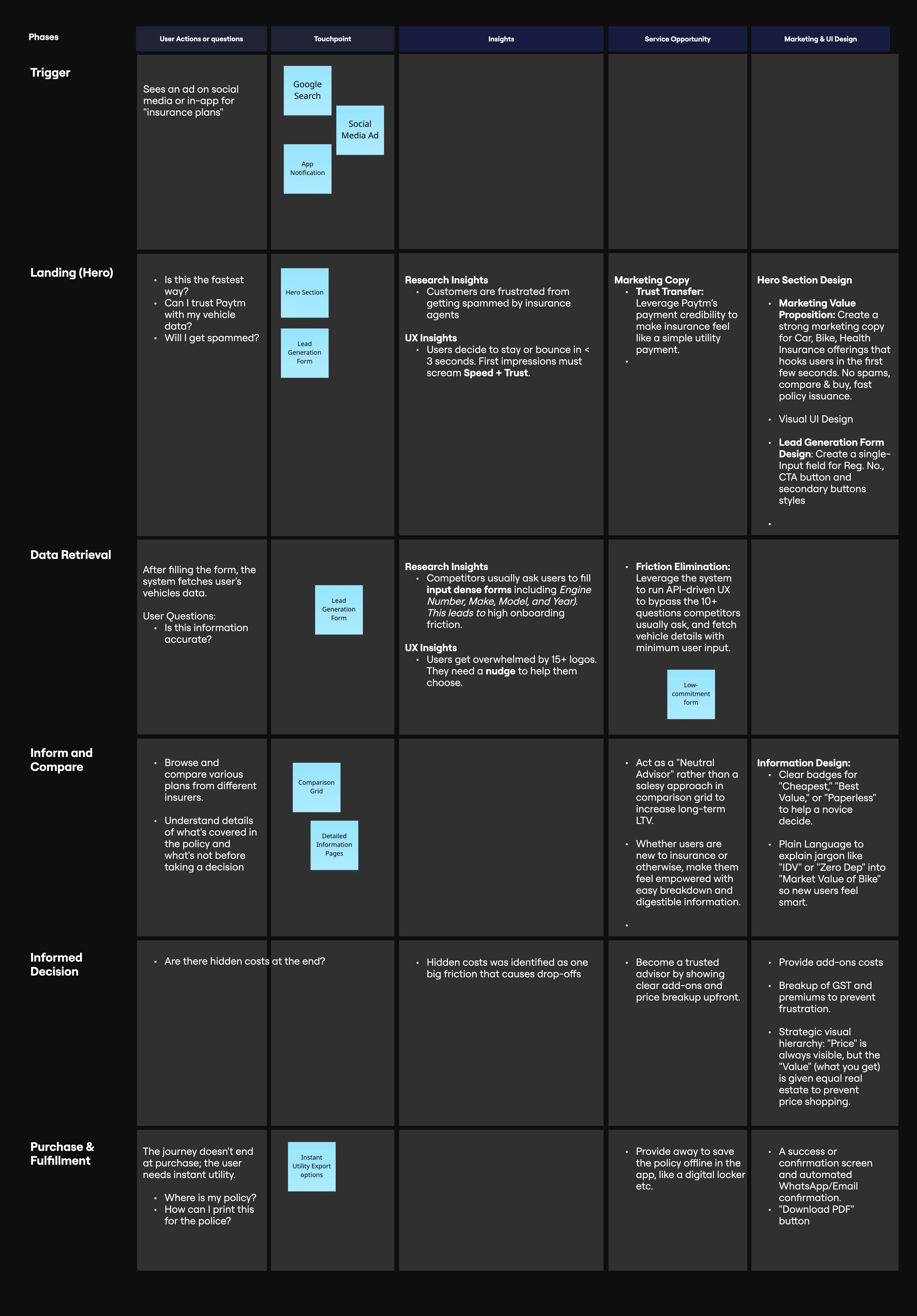
I studied drop-off data insights and then facilitated a user research session with existing users (mixed group with Paytm customers who use Paytm Insurance and those who use other Insurance providers) to identify gaps in the existing landing experience.
The data and feedback signalled three critical friction points that directly shaped the new user experience:
Spam anxiety: Users hesitated to share a phone number, expecting a wave of agent calls.
Jargon overload: Policy language caused drop-off before any comparison happened.
Hidden costs: Prices that moved late in the journey did more damage to trust than high prices did.
Native Design
Given Paytm's strong native usage dominance, a mobile-first approach was prioritised. I was responsible for designing the conversion-focused product landing screens across Car, Two Wheeler and Health Insurance. After identifying pain pointsI translated them into design opportunities.
A shift to light visual language to help category positioning
Insurance in India looked institutional and severe. I desiged a new visual vocabulary for landing pages that is lighter and modern. The designs focused on plain language headlines, generous space and approachable illustration so the promise of simplicity was legible before a word was read. Marketing design, constrained by compliance: every claim had to survive the disclosure that followed it.

Reducing form friction with
minimal lead capture
Acquisition needed leads while users needed to understand what they were buying first. The existing insurance forms asked for engine number, make, model and year before showing any value to users. Drop-off data and research pointed out that this created high perceived effort, no clear reason to trust it was worth the effort.
I resolved it by prioritising low-commitment interaction on the landing page and moving heavy data collection downstream once intent is real.
UX: Designed a single-field lead capture, and a browse-without-entering-details path for users not ready to commit so the page still works for someone in research mode.
Marketing: Created the hero copy to make the proposition and clear. Ideas included "Insure your bike in 2 minutes", "Starting at ₹1.5 per day" with a substantiating disclosure, terms appy. The copy was refined through A/B testing.

A Comparison Matrix
to establish trust at the beginning of journey
Customers expressed criticism for hidden costs leading to frustration and decision paralysis during purchase.
I designed a comparison module to clearly outline "What's covered" within Comprehensive, Third-Party and Own Damage Insurance Packages. This module was placed right at the beginning of journey to establish trust.
Price is always visible, but the value proposition (what you actually get) is given equal visual hierarchy to encourage informed selection.
Surfacing Core Benefits at the point of hesitation, not three taps away.
"Should I give my number?" spam anxiety was one of the biggest source of distrust in Indian insurance.
The benefits ("No Spam Calls" etc.) were key to providing reassurance to users. They already existed but were buried three taps away in a privacy policy that was easily missed. So I moved it up beneath the hero section as a brand promise to increase trust at the point of hesitation.
UI: Designed icons to pair with each benefit so it's more visible, scannable and isn't ignored like a footnote.

Expanded Paytm's design system with
new Iconography Library
I designed and introduced new icons for insurance products, coverage types and exclusions which became shared brand asset. This helped establish a consistent identity in the native app integration while making the experience scannable.

Impact
The hero and lead capture flow shipped first which lifted form completions by 8% within 30 days on release.